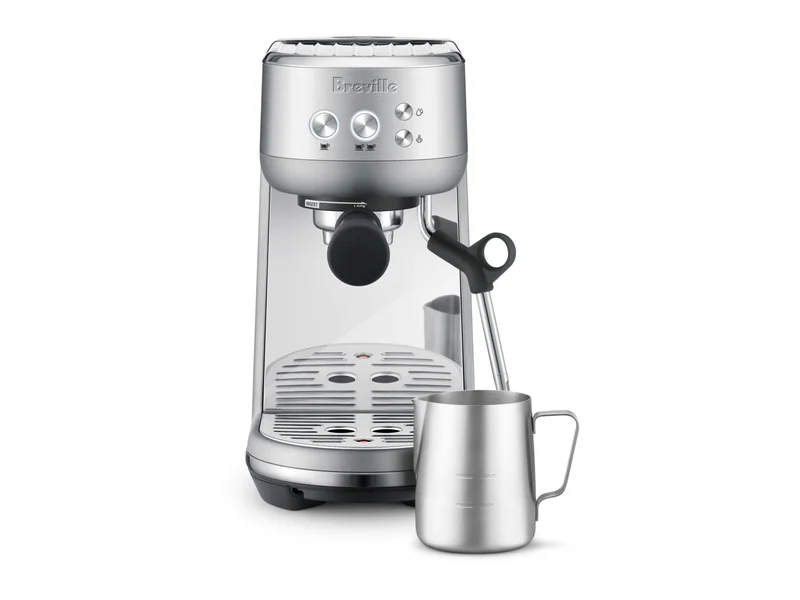
Brewing basics
Brew ratio
The weight of ground coffee compared with the weight of espresso in the cup. Writing it down helps you repeat a shot you liked. Read more: How to make espresso at home
Channeling
When water finds a weak path through the coffee puck and rushes through it, leaving the rest under-extracted. Even distribution and tamping help prevent it.
Crema
The layer of fine foam on top of a fresh espresso shot. It looks appealing but on its own does not prove a shot tastes good.
Dose
The amount of ground coffee you put in the basket, usually weighed in grams. Your basket size sets the sensible range. Read more: How to make espresso at home
Extraction
The process of water dissolving flavor from ground coffee. Too little tastes sour and thin; too much tastes bitter and dry.
Pre-infusion
A short, low-pressure soak of the coffee before full brewing pressure starts. Some machines do it automatically to help the puck extract evenly.
Puck
The compressed disk of used coffee left in the basket after a shot.
Shot time
How long the espresso takes to run, from starting the pump to stopping it. It is a useful check alongside taste and the weight in the cup.
Yield
The weight of espresso in the cup at the end of the shot. Together with the dose it gives you the brew ratio.
Machine parts
Boiler
The part of a machine that heats water. Single boiler, heat exchanger and dual boiler designs differ in how they handle brewing and steaming.
Dual-wall basket
A basket with a second inner wall and a small hole that builds pressure for you, so it is more forgiving of grind and tamp. Also called a pressurized basket. Read more: Espresso machine accessories
Group head
The part of the machine where the portafilter locks in and hot water comes out over the coffee.
Portafilter
The handle with a basket that holds the ground coffee and locks into the group head. Read more: Espresso machine accessories
Single-wall basket
A basket with many small holes and no pressure aid, so the grind and tamp do the work. It gives more control but needs a capable grinder. Read more: Best espresso grinder
Steam wand
The metal pipe that sends steam into milk to heat and texture it for drinks such as lattes and cappuccinos.
Thermoblock
A heating system that warms water as it passes through, rather than keeping a boiler hot. It heats up quickly.
Volumetric control
A setting that stops the shot after a set volume of water, so you get a similar amount each time at the press of a button.
Grinders and prep
Burr grinder
A grinder that crushes beans between two burrs set a fixed distance apart, giving a more even grind than a blade grinder. Read more: Best espresso grinder
Distribution
Spreading the ground coffee evenly in the basket before tamping, so water flows through it evenly.
Grind size
How fine or coarse the ground coffee is. For espresso it is the main setting you change to make a shot run faster or slower. Read more: Best espresso grinder
Stepless grinder
A grinder that adjusts smoothly with no fixed clicks, so you can make very small changes in grind size.
Tamper
The tool you use to press ground coffee flat and firm in the basket before brewing. Read more: Espresso machine accessories
Drinks and milk
Americano
Espresso topped up with hot water for a longer, milder cup.
Cappuccino
Espresso with steamed milk and a thicker layer of milk foam than a latte.
Latte
Espresso with a larger amount of steamed milk and a thin layer of foam.
Microfoam
Milk steamed into very small, even bubbles, giving a smooth, glossy texture that pours well.
Ristretto
A shorter espresso made with less water for the same dose, giving a smaller, more concentrated shot.
Care and maintenance
Backflushing
Running water or cleaner back through the group head with a blind basket to clean it. Only some machines are designed for it, so check the manual.
Descaling
Removing mineral scale left by hard water from the inside of a machine, using a descaling product the maker approves.
Water hardness
The amount of dissolved minerals in your water. Harder water leaves scale faster, so you may need to descale more often.
Frequently asked questions
What is the difference between a single-wall and a dual-wall basket?
A dual-wall (pressurized) basket builds pressure for you and is more forgiving. A single-wall basket relies on your grind and tamp and gives more control.
What does brew ratio mean?
It is the weight of ground coffee compared with the weight of espresso in the cup. Recording it helps you repeat or adjust a shot.
What is channeling in espresso?
It is when water rushes through a weak spot in the puck instead of flowing evenly. Even distribution and a level tamp help prevent it.
Do I need a burr grinder for espresso?
A burr grinder gives a more even grind than a blade grinder, which matters for espresso. Dual-wall baskets are more forgiving if your grinder is basic.
How often should I descale an espresso machine?
Follow your machine's manual. Harder water leaves scale faster, so you may need to descale more often.
Sources
- Breville US: the Bambino BES450(provider page)Accessed
Related guides
- How to Make Espresso at Home: A Careful First RoutineFollow a Bambino BES450 brewing sequence from basket choice and dosing to tamping, extraction and a recorded adjustment for the next shot.Read the guide
- Best Espresso Grinder for a Budget Home SetupCompare the Encore ESP, Smart Grinder Pro and J-Ultra by espresso workflow, adjustment and total cost before choosing a grinder for your US kitchen.Read the guide
- Espresso Machine Accessories: Buy What FitsCheck included Bambino accessories before buying extras, identify missing tools and assess compatibility for your chosen espresso routine.Read the guide
- Best Espresso Machine for Beginners: A First SetupChoose a first espresso workflow using the Bambino basket instructions, a simple learning plan and checks for equipment you need.Read the guide