On this page
- Breville's two portafilter sizes, by model
- Single wall and dual wall filter baskets
- What each filter basket holds
- What a bottomless portafilter does
- Which Breville pages list a naked portafilter accessory
- How to check your Breville's portafilter size
- Questions to ask before buying a basket or portafilter
- How to decide which setup fits
- Frequently asked questions
Breville's two portafilter sizes, by model
If you only remember one thing, remember the split. On Breville's US product pages, the smaller espresso machines carry a 54 mm portafilter, while the top of the range carries a 58 mm one. The number refers to the diameter of the basket the portafilter holds, and it matters because a basket or a bottomless portafilter made for one size will not seat properly in the other.
The table below lists only Breville models whose own product page in our sources states the portafilter size. Doses are the ideal dose figure each page gives, where it gives one. Two of these machines are shown as discontinued on their Breville pages, but plenty are still in kitchens, so they are worth including.
| Model | Breville portafilter size | Stated ideal dose | Notes |
|---|---|---|---|
| Bambino (BES450) | 54 mm | 18 g | |
| Bambino Plus (BES500) | 54 mm | 18 g | |
| Barista Express (BES870) | 54 mm | 18 g | |
| Barista Express Impress (BES876) | 54 mm | 18 g | |
| Barista Touch (BES880) | 54 mm | 18 g | |
| Infuser (BES840) | 54 mm | Not stated on page | Page shows discontinued |
| Dual Boiler (BES920) | 58 mm | 22 g | |
| Oracle (BES980) | 58 mm | 22 g | Page shows discontinued |
| Oracle Dual Boiler (BES995) | 58 mm | 22 g |
ModelBambino (BES450)
- Breville portafilter size
- 54 mm
- Stated ideal dose
- 18 g
- Notes
ModelBambino Plus (BES500)
- Breville portafilter size
- 54 mm
- Stated ideal dose
- 18 g
- Notes
ModelBarista Express (BES870)
- Breville portafilter size
- 54 mm
- Stated ideal dose
- 18 g
- Notes
ModelBarista Express Impress (BES876)
- Breville portafilter size
- 54 mm
- Stated ideal dose
- 18 g
- Notes
ModelBarista Touch (BES880)
- Breville portafilter size
- 54 mm
- Stated ideal dose
- 18 g
- Notes
ModelInfuser (BES840)
- Breville portafilter size
- 54 mm
- Stated ideal dose
- Not stated on page
- Notes
- Page shows discontinued
ModelDual Boiler (BES920)
- Breville portafilter size
- 58 mm
- Stated ideal dose
- 22 g
- Notes
ModelOracle (BES980)
- Breville portafilter size
- 58 mm
- Stated ideal dose
- 22 g
- Notes
- Page shows discontinued
ModelOracle Dual Boiler (BES995)
- Breville portafilter size
- 58 mm
- Stated ideal dose
- 22 g
- Notes
Breville's accessory listings also name the Oracle Touch (BES990, also shown as discontinued) at 58 mm, though its full product page is not among the ones compared here, so treat that as a secondary mention rather than a page I read end to end.
Read the pattern and the Breville espresso machine portafilter size question mostly answers itself. The single-boiler and ThermoJet machines, the ones built around a smaller footprint, use 54 mm. The dual boiler machines, including the Oracle family, step up to 58 mm. If you are still choosing a machine rather than a basket, the broader best home espresso machines guide walks through those tiers in more detail, and the dual boiler espresso machines guide covers the 58 mm end.
Single wall and dual wall filter baskets
Portafilter size is only half the story. Inside the portafilter sits a filter basket, and Breville ships two types with most of these machines: single wall and dual wall. The clearest explanation comes from the Bambino instruction book, so the wording below is specifically how Breville describes it for that machine. Other models work the same way in principle, but you should still check the manual that came with your own machine.
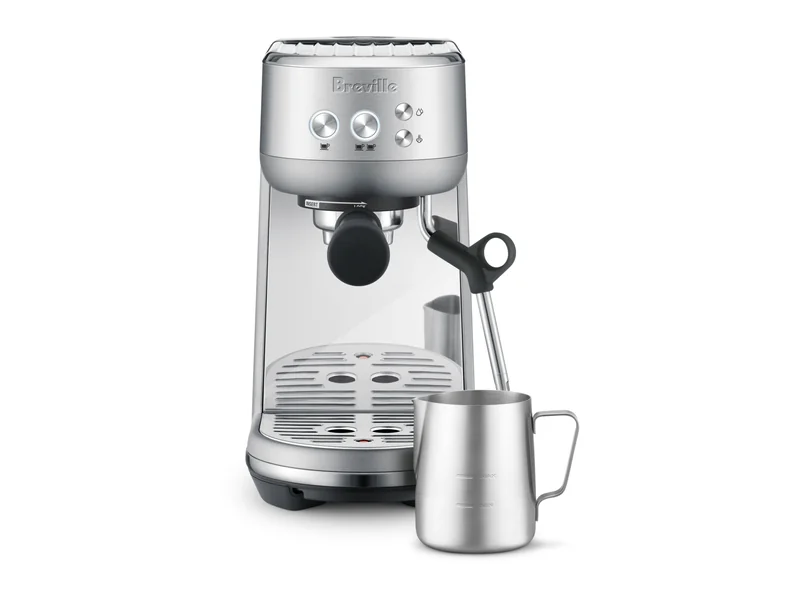
The Bambino book says to use single wall filter baskets if you are grinding fresh whole coffee beans. Single wall baskets let you experiment with grind, dose and tamp to create a more balanced espresso. In other words, they give you control, and they expect you to dial in a fresh grind.
Dual wall baskets are the other approach. The book says to use dual wall baskets if you are using pre-ground coffee. Dual wall baskets regulate the pressure and help optimize the extraction regardless of the grind, dose, tamp pressure or freshness. They are more forgiving, which is why they suit coffee that is already ground and may not be perfectly fresh.
There is a practical note in the same book worth repeating. Whether you use single wall or dual wall, use the 1 cup basket for a single cup and the 2 cup basket for two cups or a stronger single cup or mug. And when you switch from a single to a double basket, or back again, you will need to adjust the grind amount and size. That last point trips people up, so keep it in mind before you blame the machine for a sour or bitter shot. If you want the full routine around grinding and pulling, the how to make espresso at home guide covers it.
What each filter basket holds
Dose is where the espresso machine portafilter basket choice becomes concrete. The Bambino instruction book gives target weights for the baskets it ships: the 1 cup filter basket is designed for 8 to 11 g, and the 2 cup filter basket is designed for 16 to 19 g. Those figures are Breville's own, and again they are stated for the Bambino, so check your model's book before you treat them as gospel on a different machine.
Across the wider 54 mm range, Breville repeats an ideal dose of 18 g on the Bambino, Bambino Plus, Barista Express, Barista Express Impress and Barista Touch pages. The 58 mm machines aim higher. The Dual Boiler, Oracle and Oracle Dual Boiler pages each cite a 22 g dose in the larger professional style portafilter. That is the main reason the bigger basket exists: more room for more coffee, which many people pair with a larger drink.
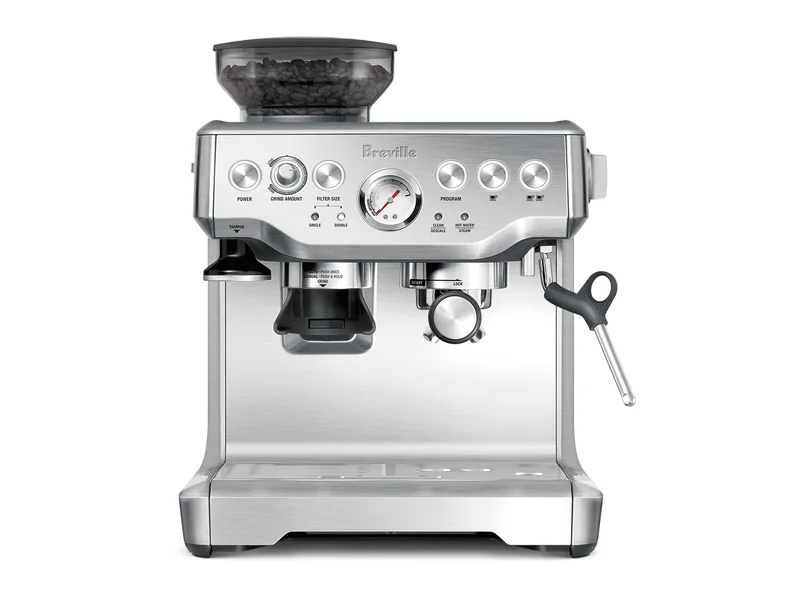
It is also why swapping a basket is not a free lunch. A basket built for roughly 8 to 11 g behaves very differently from one built for 16 to 19 g, and the grind has to move with it. Treat the basket as part of a recipe rather than a loose part.
In the box, the machines tend to come well stocked. The Bambino, for example, ships with single wall 1 cup and 2 cup baskets and dual wall 1 cup and 2 cup baskets, with the 2 cup single wall basket installed from the factory. The 54 mm machines above generally include both single and dual wall baskets in 1 and 2 cup sizes. One exception in these sources is the Oracle, whose listed accessories name single wall 1 cup and 2 cup baskets without a dual wall pair, so if you own one, confirm what is actually in your box.
What a bottomless portafilter does
A bottomless portafilter, also called a naked portafilter, is a portafilter with the spouts and the bottom of the basket seat removed, so the underside of the basket is exposed. Instead of coffee running out of one or two spouts, you watch it come straight off the bottom of the basket. If the term is new to you, the glossary has short definitions for the parts.
People use an espresso machine with a bottomless portafilter for two reasons. It looks good, with the shot visible as it forms, and it is a diagnostic tool. Uneven or squirting flow off the basket points to an uneven puck, which usually traces back to grind, distribution or tamp. A standard spouted portafilter hides that. So a naked portafilter is less about better coffee on its own and more about showing you what your prep is doing.
It is an accessory, not a different machine. The size still has to match: a 54 mm machine needs a 54 mm naked portafilter, and a 58 mm machine needs a 58 mm one. There is nothing in these sources about adapters that let one size fit the other, so do not assume that works.
Which Breville pages list a naked portafilter accessory
Breville sells its own naked portafilters, and the accessory shows up on specific product pages in both sizes. On the Barista Express Impress (BES876) page, the listed accessory is the Naked Portafilter 54 mm. That price was $99.95 as the manufacturer's US page listing on 18 Nov 2026.
For 58 mm, the Naked Portafilter 58 mm appears on both the Dual Boiler (BES920) page and the Oracle Dual Boiler (BES995) page, each listed at $99.95 as the manufacturer's US page listing on 18 Nov 2026. So the 54 mm naked portafilter is tied to the Impress listing in these sources, while the 58 mm version is tied to the two dual boiler listings.
That a page lists an accessory is a strong hint it matches that machine's size, but it is not a fit guarantee for every model, so read on for the checks worth doing. For a wider look at add-ons like tampers, jugs and dosing tools, the espresso machine accessories guide collects them.
How to check your Breville's portafilter size
The reliable way to confirm your portafilter for an espresso machine is to go to the source rather than guess. Find your exact model name and number first. Breville uses a BES prefix, so a Bambino is a BES450, a Barista Express is a BES870, and so on. That number is usually on a label on the underside or back of the machine and on the box.
With the model number in hand, look at two places. Check the model's product page, which states the portafilter size in the description or the technical specifications, and check the manual that came with the machine. When the size on the product page and the size in the manual agree, you have your answer. These sources do not give a reliable way to measure a basket at home to a tenth of a millimeter, so comparing the listed size on the page against the manual is the check I would trust, rather than reaching for calipers and hoping.
If your machine is older or discontinued, the page may say so, as the Infuser and Oracle pages do, but it will still list the size. Discontinued does not mean the size changed.
Questions to ask before buying a basket or portafilter
Fit is the buyer's job to confirm, and a few questions save returns. Before you order a replacement basket or a naked portafilter, work through these.
First, what size is my machine, 54 mm or 58 mm, confirmed from the page and the manual rather than from memory? Second, am I buying the right basket type and capacity, single wall or dual wall, 1 cup or 2 cup, for the dose I actually pull? Mixing those up is the most common mismatch, and it changes how you grind.
Third, is the part I am looking at actually listed for my model, or am I assuming it carries over because the size looks the same? These sources show naked portafilters listed on particular pages, not on every model, and they say nothing about adapters bridging 54 mm and 58 mm, so there is no adapter claim to lean on here. When a listing does not name your machine, that is your cue to verify before buying, not after. If you are newer to all this, the best espresso machine for beginners guide keeps the vocabulary simple.
How to decide which setup fits
Start from the machine you own, not the accessory you want. Confirm 54 mm or 58 mm, then let that rule out anything in the wrong size immediately. From there the choices get easy.
If you grind fresh beans and want to learn, the single wall baskets Breville ships are the ones to pull with, because they reward dialing in. If you mostly brew pre-ground coffee and want consistency without fuss, the dual wall baskets are built for that, per the Bambino book. Pick the 1 cup or 2 cup basket to match your drink size, and reset your grind whenever you switch between them.
A naked portafilter is a good fit if you want to see your extraction and troubleshoot an uneven puck, and if your machine's size matches one Breville lists, which in these sources means 54 mm on the Barista Express Impress and 58 mm on the Dual Boiler and Oracle Dual Boiler. It is less useful if you just want the same coffee with no new variables to watch. Either way, confirm the size on the page and in the manual before you spend anything.
Frequently asked questions
What size portafilter does a Breville espresso machine use?
It depends on the model. In these sources, the Bambino, Bambino Plus, Barista Express, Barista Express Impress, Barista Touch and Infuser use 54 mm, while the Dual Boiler, Oracle and Oracle Dual Boiler use 58 mm, per Breville's own pages.
What is the difference between single wall and dual wall baskets?
The Bambino book says to use single wall baskets with freshly ground whole beans, since they let you adjust grind, dose and tamp. Dual wall baskets suit pre-ground coffee because they regulate pressure and help the extraction regardless of grind or freshness.
Does a Breville machine come with a bottomless portafilter?
Not in these sources. Breville lists the naked portafilter as a separate accessory, showing a 54 mm version on the Barista Express Impress page and a 58 mm version on the Dual Boiler and Oracle Dual Boiler pages, each at $99.95 as the manufacturer's US page listing on 18 Nov 2026.
How much coffee does a Breville basket hold?
The Bambino instruction book gives 8 to 11 g for the 1 cup basket and 16 to 19 g for the 2 cup basket. The 54 mm machines cite an 18 g ideal dose, and the 58 mm Dual Boiler, Oracle and Oracle Dual Boiler cite 22 g.
How do I check which portafilter size my Breville is?
Find your model number, which starts with BES, then compare the portafilter size listed on that model's Breville product page with the size in your machine's manual. When the page and manual agree, you have a confirmed size to shop against.
Sources
- Breville Bambino instruction book(provider page)Accessed
- Breville Bambino product page(provider page)Accessed
- Breville Bambino Plus product page(provider page)Accessed
- Breville Barista Express product page(provider page)Accessed
- Breville Barista Express Impress product page(provider page)Accessed
- Breville Barista Touch product page(provider page)Accessed
- Breville Infuser product page(provider page)Accessed
- Breville Dual Boiler product page(provider page)Accessed
- Breville Oracle Dual Boiler product page(provider page)Accessed
- Breville Oracle product page(provider page)Accessed
Related guides
- Espresso Machine Accessories: Buy What FitsCheck included Bambino accessories before buying extras, identify missing tools and assess compatibility for your chosen espresso routine.Read the guide
- Best Home Espresso Machine for a $500 SetupCompare home espresso setup choices for a $500 planning limit, with Bambino basket guidance and a checklist for complete checkout costs.Read the guide
- Best Espresso Machine for Beginners: A First SetupChoose a first espresso workflow using the Bambino basket instructions, a simple learning plan and checks for equipment you need.Read the guide
- How to Make Espresso at Home: A Careful First RoutineFollow a Bambino BES450 brewing sequence from basket choice and dosing to tamping, extraction and a recorded adjustment for the next shot.Read the guide